Wednesday, April 6, 2016

A good feeling

When we rise above our insecurities, when we overcome the limitations our minds holds us within, at such times we do things that make us feel good about ourselves.
As I approached the squash court today, I made a commitment to myself that I would attempt to break out of the 'giving up' mindset I had slipped into in the last few weeks.  Either I would lose close matches or not even attempt a fightback in those ones in which I had lost early advantage.
This meant I was scrambling for a solitary win in a set of five games or giving up after 4 matches. 
So today I took the fight to the competition from the word go.  I won the first game. I fought hard right from the start putting my everything  into preventing a recovery by my dogged opponent.  The next match I lost despite an advantage early in the game. However a late comeback and a tight finish was a consolation that I hadn't succumbed easily.
At this point we took a break.  Refreshed, I returned to take the next game easily.  Usually we continue straight into game four but this time I requested for a break. I knew my opponent had far better stamina than me and typically beat me in the fourth by the end of which  I hadn't any energy left for the fifth.  Today by taking the break I wanted to be in a better position to win the fourth and thereby the match.
The plan worked.  I won the fourth and therefore the match 3-1 but I still had the fifth match to play if I wished but without the break which I had already consumed. I decided that despite the fact I was tired I would not merely play it but try and win it as though it was the decider.

It was among the toughest match I had ever played.  It see-sawed wildly and had so many rallies that I was dog-tired midway through it.  I was folding up and barely able to lift my racket.
I took a lead and was 12-9 ahead. But my adversary played incredibly to equalize. My mind was numb and swirling.  It was telling me to give up this inconsequential match. But somewhere deep inside me I heard a voice egging me on to win. My opponent went ahead and made it 12-13.
I fought hard and equalized. Then I won the next point. Game point! 
To my horror my opponent was in no mood to relent. He made it 14-all. One point for either to win. It was that close.
I stepped out moments later. I had set myself a victory margin of 4-1 and I had done it.
A great feeling indeed.

Saturday, April 2, 2016

Dhoni and the Cult of the Leader

A few days back an interesting conversation between Harsha Bhogle and Shane Warne shed light on why the Indian team is unable to get beyond the semi finals in recent major tournaments.
Harsha Bhogle began talking about the inevitability of fate and a 'sense of what lay ahead', while Shane Warne spoke with clarity on the fact that when there's a target to get or batsmen to get out, someone has to go out and do it. In an regular match sometimes a  individual does it, however in a tournament especially a major one it becomes difficult for one or two players to do so match after match.  It requires the entire team to play consistently well, to win such tournaments.  Which is lacking in the Indian team.

Save for Virat, Nehra and a couple of others, the Indian team has been carrying a bunch of under performers for some time now.  In crucial situations these under performers fail the team and drag down India's chances especially against quality opposition who India encounter in semifinal situations.

How do under performers make it to the team? Why are they retained? And why weren't they there earlier?

The answer to this is the curious aura of the 'cult leader'.
Let's examine the leadership path of Dhoni. His greatest phase was between 2007-11. In this time he won everything even the IPL trophy. Then in the phase 2012-2016 he lost most major tournaments in the semi/final stage.  Actually he didn't lose it. His team lost it.
In the first phase he  inherited a team full of seniors. His choices to change them were limited and he hadn't the ego to change them so channelled the seniors and juniors to perform at their best.  It was a great team and ensured victory.
But in India we gave Dhoni total credit believing he can make any team successful.  Perhaps he thought the same. 
Now Dhoni began to select the team of his choice.  This had players loyal to him and players he believed brought him luck. This caused the early exit of some key seniors.  But the nation backed him.
Dhoni succumbed to the cult of the absolute leader who believed that he could win any match with the team he chose.  He ignored the failures of key players and continued with them. He refused to bring in better players who sat on the sidelines.
This is why India and CSK would consistently lose at the knockout stages of major tournaments.

A leader is only as good as his team. The moment a team is chosen on the basis of loyalty or superstition it undermines its own chances of victory.

Wednesday, March 2, 2016

No application for old men


“Rajan what is this?”
My 82-year old father was holding out a newspaper insert of a food app that was promising a free samosa and lassi combo from a famous halwai, close by.
“Appa this is a mobile app that delivers food from eateries in the vicinity.”
“That’s OK but where’s the telephone number that I can call to get this free offer?” Dad asked as he continued to look minutely at the leaflet for the elusive number
 I explained as patiently as I could, “Appa, there’s no number, you have to download the app on your smartphone and order through it only to avail of this offer.”
Appa had refused to keep a smartphone. The screen was too tiny for him to read articles and the continuous stream of jokes on watsapp had left him exasperated.
“So you’re telling me I can’t avail of this offer simply because I don’t have a smartphone? I can’t believe this. In India how many people have smartphones? The majority have simple phones like mine. So we are unwanted is it? Wait let me call the halwai, he’ll give me this directly.”
 Of course that didn’t happen and a much chagrined Appa said in wonderment, “He says the offer is not from him but from the app people who pay him full price! That would cost a lot! Why do they want to feed wealthy people for free and not give this to the poor people without smartphones?”
 Time I broke the truth to him, I thought and told him gently, “Appa, this company is giving its potential audience an introductory offer to get them on the app and then make them use it frequently, thereby making it a habit and acquiring customers for life.”
 “But this must be a long drawn affair and how will the company make money? Pay salaries in the interim?”
 “Yes Appa, there’s no time frame to this. The money they get from investors: PE firms, VC’s seed fund and angel investors who pay them millions of dollars.”
“I don’t get it. These investors pay delivery companies to make huge losses but won’t give that money to existing restaurants and hotel chains? They’re banking on the fact that people will get lazier? Not want better food?”
 “I’m not sure about what their plans are Appa, but yes they believe these companies are the future. By the way, should I order you a samosa and lassi?”
 “Forget it! I asked for this because it was free. Otherwise who wants to eat that halwai’s stale samosa?”

Friday, February 26, 2016

Arjuna Vs Drona & it's relevance to the Budget Session of Parliament


Respected Members of Parliament,
As you sit through the critically important budget session, let me extract a part from one of the world's greatest epics, The Mahabharata to underscore a point.
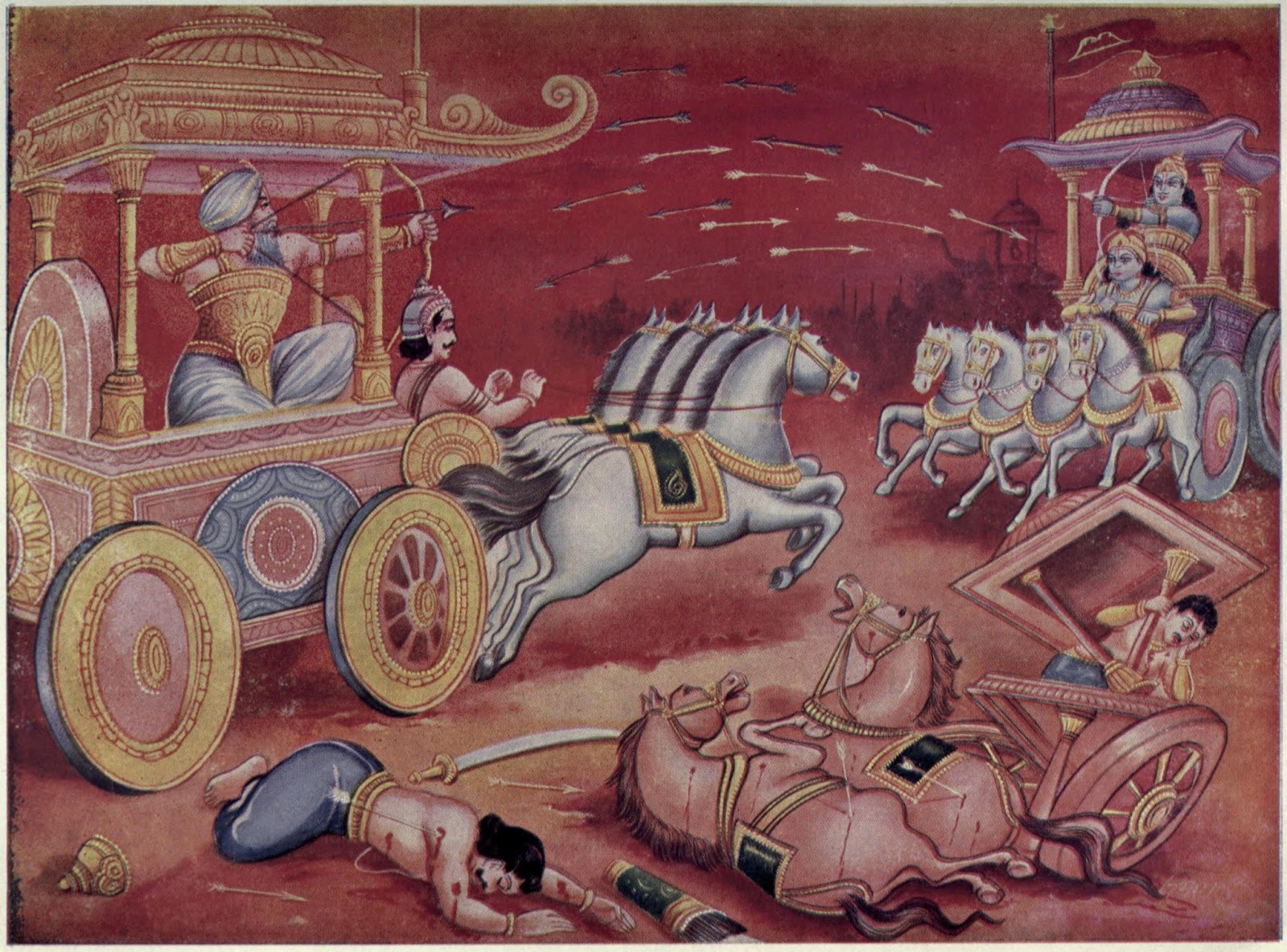
It was past mid-day on the 14th day of the Kurukshetra war. Arjuna had sworn to cut Jayadrath's head by the end of that day else kill himself. Cunning Duryodha seeing an opportunity to eliminate Arjuna, placed Jayadratha right at the back, with Karna in the center and Drona up ahead.
His strategy was simple. Only two of his generals could kill Arjuna, Drona and Karna. By putting both in Arjuna's path, either Drona or a fresh Karna facing a tired Arjuna (post a tough battle with Drona) would kill Arjuna. Even if they didn't, they would keep Arjuna engaged till sundown, thereby forcing Arjuna to keep his pledge and kill himself. 
The plan seemed to be working as Arjuna had just about reached Drona's position by mid-day. However, the All-knowing Krishna had seen through Duryodhana's plan. As Drona reached down to lift his bow and begin battle with Arjuna, Krishna whispered something to Arjuna. Drona looked up and was surprised to see an unarmed Arjuna get off his chariot and approach him on foot. Before he could collect his wits, Arjuna lay at his feet and said, "Dear Drona, you are my guru and my father. Today I have taken a pledge to kill Jayadrath and I seek your blessings and support to accomplish this." Drona was left with no other choice but to bless him and allow him the right of passage.
Similarly, Krishna brought forth Bheema to take on Karna in an epic battle, thereby diverting all the hurdles in Arjuna's path. Arjuna then in the nick of time severed Jayadrath's head, keeping his pledge, destroying the Kaurava army's morale, thus leading to its eventual defeat and destruction.
Why am I quoting this to you today? In the budget session, it is vital that policy matters with regards to economy and reforms are taken up, debated, amended (if needed) and passed. For this to happen, everyday the Parliament is in session, these matters must be given priority. However, the JNU issue has laid siege to the Parliament all of last week without a single critical bill being discussed or passed. The JNU issue is like Drona. It is important but not urgent and critical. You, honorable members must quickly find a way to circumvent it and immediately engage with the key matter of economic policy.
Like Krishna we must know how to prioritize our battles and like Arjuna we must know which is the immediate enemy we need to tackle.

Monday, February 22, 2016

#Businesslessons #CEOlessons #leadershiplessons

My two-bits as a CEO, #entrepreneur, #founder and #startup

1. Focus on  building differentiation for your company, not on the bottom-line. For a strong bottom-line is merely the outcome of a uniquely differentiated company.

2. Don't waste time looking for the perfect team. Instead understand the potential of your current team and put all your effort in optimizing their output.

3. An organizational culture is nothing but a manifestation of your own personality. Therefore your organization's culture cannot be built by posters and emails. It will be built by your own behavior.

4. Your longevity at the company's helm is equally a function of how you handle your investors as much as your handling of their investment :)

5. Your greatest enemy is isolation. The more you find yourself spending time with yourself and taking decisions based on your own gut-feel, greater is the chance of them being wrong. The greatest of leaders aren't those who come up with the best solutions always. On the other hand, they are those who know how to identify and spot the right solutions consistently from the multitude thrown up by their own team members.

6. Every leader has an expiry date. Instead of focusing on the length and time-span, work towards having an impact in that duration. That is what will be remembered.

Thursday, February 18, 2016

Lessons from a Leader. #Shivaji #maharashtra #startup #enterprise #management

On Shivaji Jayanti, let's recall the lessons this great hero set by example:
1. Objective Clarity. Freedom from an oppressive rule was his singular objective and everything else was judged by its delivery to this.

2. Mother is supreme. Ma. Motherland. Mother Nature. Shivaji built his life's mission around his mother's clarion call, "Freedom". He immediately understood the scale and vision of her command. No man can err if he follows his creator's call.

3. Meritocracy. He selected his generals based on their ability not on caste or religion. 

4. Believe in the team. Shivaji developed a second level team which went on to create their own kingdoms.

5. Righteousness even with the enemy. Shivaji limited his war to an ideology. He treated the family of his enemies and prisoners with respect and great humanity. 

6. Strategy. He introduced guerilla warfare for the first time as the principal strategy because it suited the terrain he inhabited and the fact that his army was tiny.

7. Self-belief. Despite the fact that he was starting from scratch and was up against the world's largest army, he was confident of the outcome. He never let doubt creep in even during times of failure and achieved the impossible against all odds.

Shivaji is every Indian's hero. He fought oppression, built a nation, valued and cared for people, believed in merit not background. And never ever gave up.

Remember him. Be inspired by him.

#Shivaji #maharashtra #startup #enterprise #management